The safer operation depends on tumour stage, resectability and the surgeon’s ability to remove all visible cancer with clear margins—not simply on whether a robotic system is available. You will learn how to compare robotic and open surgery, what staging tests matter, and which questions reveal whether a proposed operation is an appropriate cancer resection.
Key takeaways
- Confirm whether cancer requires liver and lymph-node removal, not gallbladder removal alone.
- Ask which scans establish tumour stage and whether bile-duct involvement is present.
- Compare cancer margins, lymph-node clearance, conversion risk and recovery—not incision size alone.
- Choose a surgeon who explains the proposed operation and its safety checks clearly.
Why gallbladder cancer surgery is different from gallstone surgery
A simple cholecystectomy is inadequate when cancer has penetrated beyond the inner gallbladder lining or appears to extend into the liver, lymph nodes or nearby bile duct. The operation must remove the tumour with a cancer-safe margin, not merely detach the gallbladder as treatment for stones.
T1a cancer, confined to the lamina propria, is commonly treated with cholecystectomy alone after pathology confirms clear margins. For T1b disease, which reaches the muscle layer, many hepatobiliary teams discuss a second operation because residual cancer risk is higher.
T2 disease and selected T3 disease often require removal of the gallbladder bed, usually liver segments IVb and V, together with regional lymph-node dissection.
The gallbladder cancer surgery options depend on scans, pathology and whether complete removal is technically possible. Extrahepatic bile-duct resection is not automatic; it is considered when the cystic-duct or bile-duct margin contains cancer, the duct is directly invaded, or reconstruction is needed for a clear margin.
Adding it without a cancer reason increases risks such as bile leak and bile-duct stricture.
If cancer is discovered after routine gallbladder removal, you may need planned completion surgery rather than observation. The team reviews the T stage, liver-bed and cystic-duct margins, imaging and your fitness before deciding; repeating the operation robotically is not automatically safer or sufficient.
How tumour stage determines the operation
Tumour depth sets the starting point, but liver invasion, bile-duct margins, lymph nodes and distant spread decide whether surgery can remove all visible cancer safely.
These findings determine gallbladder cancer surgery options:
- T1a, limited to the inner mucosal layer, is often treated with cholecystectomy alone if the specimen and margins are clear. T1b disease enters muscle and needs specialist review for additional liver-bed and lymph-node resection.
- T2 disease extends into connective tissue beneath the muscle. Curative surgery generally removes the gallbladder bed, often liver segments IVb and V, plus regional lymph nodes.
- T3 disease reaches the liver or another nearby structure. Surgery remains possible only when scans show complete removal is achievable; the plan may require a wider liver resection or combined-organ procedure.
- T4 disease involves major vessels or multiple organs. It often requires systemic treatment rather than an upfront curative operation, unless a specialist team identifies a genuinely resectable pattern.
Direct bile-duct invasion, or cancer at the cystic-duct or bile-duct margin, can require extrahepatic bile-duct removal and reconstruction. Adding that step without invasion increases bile leaks and strictures, so it is not routine.
Bulky or fixed regional nodes can make clearance unsafe. Surgeons assess an adequate regional-node dissection; examining at least six nodes supports more reliable staging.
Distant spread to the liver, lungs or peritoneum usually shifts treatment away from curative surgery. Open surgery becomes the safer first approach when invasion, fixed nodes, major-vessel involvement or complex reconstruction prevents controlled minimally invasive dissection.
Robotic versus open surgery: the practical trade-offs
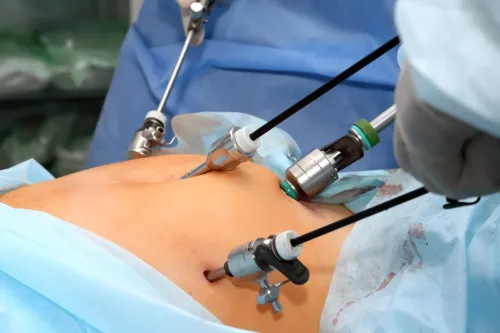
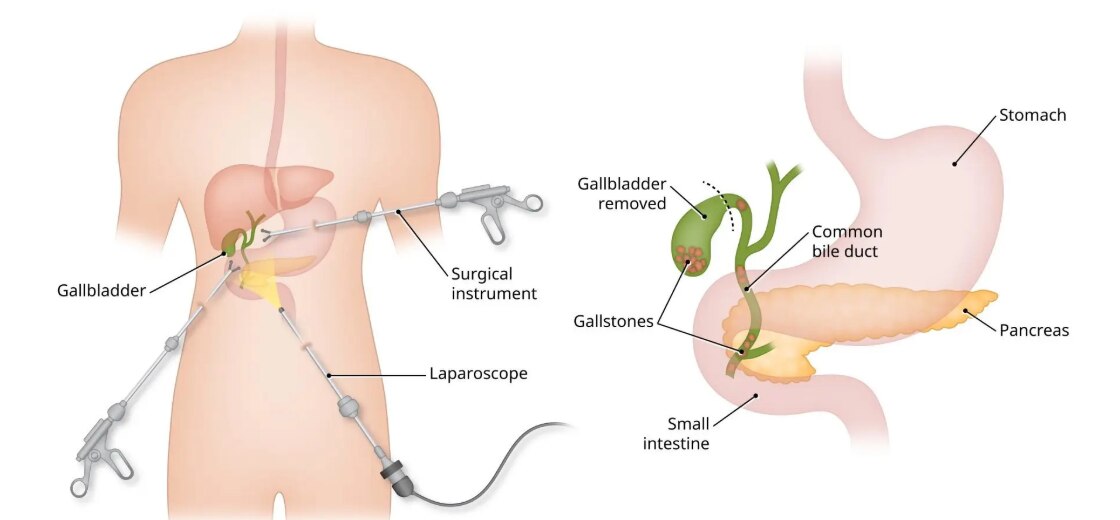
Robotic surgery usually offers smaller incisions, less early pain and a shorter hospital stay, while open surgery provides wider access and direct exposure. Neither approach has proven better long-term cancer survival when a properly performed oncologic resection is possible. The safer choice depends on anatomy, tumour extent and the surgeon’s ability to obtain clear margins.
| Option | Access and exposure | Wounds, pain and recovery |
|---|---|---|
| Robotic biliary surgery | Small ports, three-dimensional magnified vision and wristed instruments improve work around the liver bed and bile ducts, but exposure remains limited by bulky tumours, adhesions or bleeding. | Smaller scars, less early pain and a shorter stay are possible in selected patients. Recovery is usually quicker, but internal healing still takes time. |
| Open surgery | A larger upper-abdominal incision gives direct access for liver resection, lymph-node clearance, bile-duct work and control of major bleeding. | More wound pain, a longer admission and slower return to normal activity are expected. The scar is longer and more visible. |
If you are comparing robotic gall bladder cancer surgery versus open surgery Hesaraghatta, ask which approach can safely remove the tumour, liver margin and regional nodes without spillage.
A robotic operation should be converted deliberately, not stubbornly continued, when anatomy is unclear, bleeding is uncontrolled, adhesions block safe dissection, the tumour cannot be separated from nearby structures or a clear margin is doubtful. Planned conversion is safer than forcing minimally invasive access and causing tumour rupture, bile-duct injury or incomplete cancer clearance.
The tests and cancer-safety checks before choosing an approach
Contrast CT of the chest, abdomen and pelvis is the baseline map: it shows liver-bed invasion, enlarged lymph nodes, major-vessel contact and distant spread. MRI with MRCP clarifies bile-duct involvement and vascular anatomy; PET-CT is reserved for selected cases when CT or MRI leaves uncertainty, not as a substitute for tissue diagnosis.
Ask the team to confirm these checks before choosing robotic or open access:
- Review the biopsy or gallbladder specimen by a specialist gastrointestinal pathologist, including T stage, cystic-duct margin, liver-bed margin and tumour perforation.
- Check complete blood count, bilirubin, liver enzymes, albumin, creatinine and INR. These tests assess fitness and reveal obstruction or impaired liver function; CA 19-9 and CEA support assessment but do not prove cancer.
- Have a hepatobiliary surgeon, radiologist, pathologist and medical oncologist review the scans and pathology together.
- Discuss diagnostic laparoscopy when small-volume peritoneal spread or an unresectable finding remains possible.
| Check | What it answers | Surgical consequence |
|---|---|---|
| Contrast CT chest/abdomen/pelvis | Liver, nodes, vessels and distant disease | Defines resectability and possible open access |
| MRI/MRCP | Bile-duct and vascular anatomy | Tests whether clear ductal margins are feasible |
| Pathology review | Depth, margins and perforation | Determines completion surgery and spillage risk |
| MDT review | Whether liver and regional-node clearance is achievable | Selects robotic, open or non-operative treatment |
For robotic gall bladder cancer surgery in Hesaraghatta, insist on an oncologic plan for segments IVb/V, regional nodes and controlled specimen extraction. Convert to open surgery if exposure, bleeding or margin control threatens cancer safety.
How to assess a Hesaraghatta surgeon and a proposed operation
A surgeon’s robotic gallstone case count does not prove experience with robotic hepatobiliary cancer surgery. For robotic gall bladder cancer surgery in Hesaraghatta, ask for recent, case-specific results rather than a clinic title or machine brand.
1. Verify the surgeon’s full name, medical registration, hospital privileges and hepatobiliary or surgical-oncology training. A search label such as “Dr Santosh gallbladder surgeon” is not proof of specialist experience. Ask who would perform an open conversion and who would manage a bile leak, bleeding or bowel injury.
2. Request the surgeon’s recent number of gallbladder-cancer resections, including completion operations after an incidental diagnosis. Ask how pathology, T stage, liver-bed and cystic-duct margins determine whether a second operation is needed; robotic reoperation is not automatically appropriate.
3. Ask for the practice’s own figures over a defined period: robotic-to-open conversion rate, bile-leak rate, reoperation rate, postoperative mortality, lymph-node yield and proportion of cases with clear microscopic margins. Compare like with like—cancer resections, not routine gallstone cholecystectomies.
4. Confirm that each case is reviewed by a multidisciplinary hepatobiliary oncology team. The proposed plan should state whether it includes liver segments IVb/V, regional nodes, or bile-duct resection, and why. Bile-duct removal is not routine; unnecessary reconstruction can add leaks and strictures.
Robotic Cancer Surgery can be a useful local consultation, but the decision should rest on stage, resectability, documented outcomes and a credible rescue plan—not proximity to Hesaraghatta.
Related service
Gall stones treatment near me ROBOTIC GALL BLADDER AND BILIARY SURGERY Robot-assisted gallbladder and biliary surgery represents a significant advancement in treating gallbladder diseases and disorders of the biliary... View service → |
Frequently asked questions
Why is gallbladder cancer surgery different from gallstone surgery?
Gallstone surgery usually removes the gallbladder alone. Cancer surgery can require removal of nearby liver tissue, regional lymph nodes and, when involved, part of the bile duct to achieve a cancer-safe margin.
How does tumour stage determine the operation?
The depth of tumour invasion, liver involvement, lymph-node spread and bile-duct involvement determine whether surgery is appropriate and how extensive it needs to be. Imaging and pathology guide that decision.
How do robotic and open gallbladder cancer surgery compare?
Robotic surgery uses smaller access points and articulated instruments, while open surgery uses a larger incision and direct access. The practical comparison includes tumour extent, surgeon experience, operating time, conversion risk, recovery and the ability to achieve a clear margin.
What tests and safety checks should happen before surgery?
Ask about contrast CT or MRI, liver-function tests, chest assessment, review of lymph nodes and bile ducts, and discussion by the appropriate cancer team. Confirm how the surgeon will assess margins and unexpected spread.
How should you assess a Hesaraghatta gallbladder cancer surgeon?
Ask how often the surgeon performs complex gallbladder and biliary cancer operations, which operation is proposed, what could require conversion to open surgery, how lymph nodes and margins will be assessed, and where complications would be managed.
Keywords