A gynecologic tumour becomes a gastrointestinal surgical problem when it reaches the bowel, rectum, omentum, peritoneum, mesentery, abdominal wall or another abdominal structure. By the end, you will know when a GI oncosurgeon is added, how stage and tumour location affect the operation, and when robotic surgery gives way to laparoscopy or an open procedure.
Key takeaways
- Ask which organs the tumour involves and whether bowel resection is planned.
- Confirm who will perform each part of the operation and manage complications.
- Ask how a stoma, bowel recovery and hospital stay could affect you.
- Compare robotic expertise with experience in complex bowel and pelvic cancer surgery.
Why a gynecologic cancer team may include a GI oncosurgeon
A gynecologic oncologist usually leads diagnosis, staging and treatment planning for ovarian, fallopian-tube, primary peritoneal, endometrial, cervical, vulvar, vaginal and uterine cancers. A GI oncosurgeon joins when the tumour reaches the small or large bowel, rectum, mesentery, omentum, peritoneum, stomach surface, liver capsule, diaphragm, retroperitoneum or abdominal wall.
The GI oncosurgeon assesses whether involved digestive or abdominal tissues can be removed and reconstructed safely during an operation led by the gynecologic oncologist. That collaboration can involve bowel resection, tumour stripping from surfaces or repair of another abdominal structure; robotic access does not change who must perform each specialised part.
| Specialist | Main responsibility | Role in a combined operation |
|---|---|---|
| Gynecologic oncologist | Cancer diagnosis, staging and treatment plan | Leads the gynecologic tumour operation |
| GI oncosurgeon | Bowel and complex abdominal tumour surgery | Removes or reconstructs involved gastrointestinal or abdominal structures |
| General surgeon | Broad surgical conditions | Helps with surgical problems but may not have oncology or pelvic cancer expertise |
| Medical oncologist | Chemotherapy and systemic treatment | Plans drug treatment before or after surgery |
| Radiation oncologist | Radiotherapy | Plans radiation when the cancer and stage require it |
A search such as gi oncosurgeon robotic gynecologic tumour surgery for dasarahalli is only a starting point. Confirm formal oncology training, relevant bowel experience and collaboration with a gynecologic oncologist; location or the word “robotic” does not prove suitability.
Which tumours and disease features make GI involvement more likely
An added GI oncosurgeon is justified when removing the gynecologic primary alone is unlikely to clear all visible cancer. The goal may be complete cytoreduction, including disease on bowel, rectum, mesentery, omentum, peritoneum, diaphragm or abdominal surfaces.
| Tumour group | Features raising GI involvement | Surgical implication |
|---|---|---|
| Ovarian or fallopian-tube | Advanced stage, ascites, large masses, omental or peritoneal deposits | Bowel-surface stripping or intestinal resection may be needed |
| Endometrial or uterine | Large uterus, extrauterine spread, pelvic sidewall or bowel-adjacent disease | Combined pelvic and bowel planning |
| Cervical, vulvar or vaginal | Extension into the rectum, sigmoid colon, pelvic sidewall or adjacent organs | Assess resection and reconstruction needs |
| Pelvic sarcoma | Large, infiltrative or recurrent tumour crossing tissue planes | GI input helps judge safe, complete removal |
| Benign fibroid | No malignant diagnosis or cancer spread | Does not require cancer cytoreduction or a GI oncosurgeon |
Scans can miss thin deposits on the bowel surface or mesentery even when no bowel-wall mass appears. Stage, tumour location, prior operations and adhesions determine whether safe dissection and bowel reconstruction are realistic. Distant metastases may shift treatment toward systemic therapy, although selected patients still undergo surgery after multidisciplinary review.
A search for gi oncosurgeon for gynecologic cancer peenya is only a starting point. Confirm the pathology, stage, resectability and complete treatment plan with the gynecologic oncologist before choosing robotic access; the platform cannot compensate for an unsuitable operation or incomplete cancer assessment.
What operation is being proposed, and why the access route matters
The proposed operation—not the robot—determines the access route. Primary tumour removal, formal staging, interval debulking after chemotherapy, recurrence surgery, bowel resection, and cytoreductive surgery with HIPEC have different technical demands.
| Operation | Main purpose | Access question |
|---|---|---|
| Primary removal | Remove the originating tumour | Can margins be obtained safely through small ports? |
| Formal staging | Inspect or remove nodes, peritoneal samples and other tissues | Will minimally invasive access provide complete pathological staging? |
| Interval debulking | Remove residual disease after chemotherapy | Can all visible disease be removed, including bowel or surface deposits? |
| Recurrence surgery | Treat cancer that has returned | Do adhesions or altered anatomy make open access safer? |
| Bowel resection | Remove involved intestine and reconstruct it | Can the team create a safe join or stoma? |
| Cytoreduction with HIPEC | Remove visible disease before heated intraperitoneal chemotherapy | Is wide access needed for complete clearance and perfusion? |
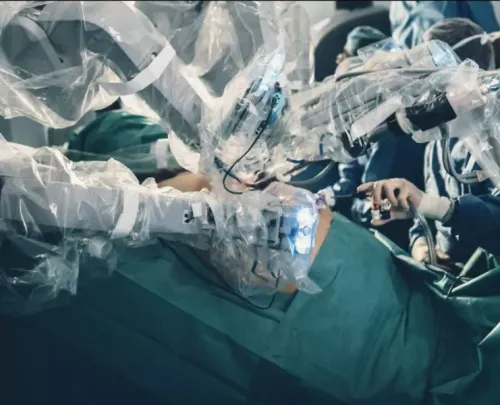
Robotic surgery is an access technique. It does not replace pathological staging, lymph-node assessment when indicated, safe margins, chemotherapy, or radiotherapy.
A minimally invasive approach is supported when disease can be removed completely and safely, you can tolerate carbon-dioxide pneumoperitoneum and steep Trendelenburg positioning, and the team can perform the planned bowel or urinary reconstruction.
- Choose open surgery when disease is extensive, major blood vessels are involved, complete robotic removal is unrealistic, your medical status is unstable, or rapid wide abdominal access is needed.
- Ask about conversion if adhesions, bleeding, unexpected spread, unsafe margins, or reconstruction problems arise; conversion protects safety.
- Discuss cervical-cancer surgery separately: the LACC trial reported worse disease-free and overall survival with minimally invasive radical hysterectomy than with open abdominal radical hysterectomy.
A search for “robotic cancer surgery for women yeshwantpur” should lead to this operation-specific discussion, not a platform-based decision.
What bowel surgery can change before, during and after the operation
If a gynecologic tumour may involve the bowel, ask whether surgery could remove an intestinal segment, strip tumour from the bowel surface, or resect the rectum.
- Which bowel procedure is most likely, and could the surgeon reconnect the ends immediately with a primary anastomosis?
- If the join is unsafe, would you receive a temporary diverting stoma, and under what circumstances could it become permanent?
- What is the team’s conversion rate from robotic to open surgery, and what findings would trigger conversion?
- Could you require intensive-care monitoring, and who will provide chemotherapy or radiotherapy after recovery?
The final reconstruction can change during the operation. Poor blood supply, unhealthy bowel, contamination, extensive tumour, or a join that cannot be tested as safe can make diversion safer than immediate reconnection. A permanent stoma is less common, but the possibility matters before consent.
Small robotic incisions do not remove bowel-specific risks. Anastomotic leak can cause peritonitis or an abscess; ileus or bowel obstruction can delay eating and discharge. Bleeding, infection, reoperation and stoma creation remain possible after bowel resection.
The surgeon may convert to an open operation if dense adhesions limit access, scans have missed tumour spread, bleeding is difficult to control, safe margins cannot be obtained, or bowel reconstruction becomes unsafe. Conversion is a safety decision, not proof that the operation has failed.
Ask where the stoma would sit, how it would be managed, and whether reversal would require another operation.
How to judge whether a local robotic cancer team is the right fit
A nearby team is the right fit only if it can show the expertise and backup required by your tumour, not merely offer a robotic platform. Treat searches such as “robotic surgeon gynecologic tumour nelamangala” as convenience filters, then verify the following:
- The named surgeon has formal surgical-oncology training and experience with your proposed gynecologic operation, bowel resection, rectal surgery or cytoreduction.
- The team includes a gynecologic oncologist, colorectal surgeon, medical oncologist, radiation oncologist, radiologist and pathologist when your case requires them.
- Your scans and biopsy are reviewed at a multidisciplinary tumour meeting, with a recorded stage and treatment plan.
| Evidence to compare | Strong answer | Warning sign |
|---|---|---|
| Lead surgeon | Names who will operate and who will perform bowel work | “The team” without named roles |
| Tumour removal | Explains whether complete cytoreduction is realistic and why | Promises removal without discussing spread |
| Access route | Compares robotic, laparoscopic and open surgery for your anatomy | Says robotic is automatically better |
| Conversion | Gives the unit’s conversion experience and safety triggers | Avoids the question |
| Aftercare | Names who will direct chemotherapy or radiotherapy | Leaves oncology follow-up unclear |
Ask about the likely bowel procedure, stoma risk and intensive-care access. A Bengaluru practice such as Robotic Cancer Surgery should be assessed by these capabilities, not its location, platform or the word “robotic” alone. Your consent should follow a specific plan, not a search result.
Related services
ROBOTIC SURGERY FOR GYNECOLOGICAL TUMOURS ROBOTIC SURGERY FOR GYNECOLOGICAL TUMOURS Robotic surgery has significantly advanced the treatment of gynecological tumors by providing surgeons with enhanced precision and control. View service → |
ROBOTIC CYTOREDUCTIVE SURGERY AND HIPEC ROBOTIC CYTOREDUCTIVE SURGERY AND HIPEC Robotic cytoreductive surgery combined with hyperthermic intraperitoneal chemotherapy (HIPEC) represents a cutting-edge approach in treating advanced... View service → |
Frequently asked questions
Why might a GI oncosurgeon join a gynecologic cancer team?
A GI oncosurgeon may join when a gynecologic tumour reaches the bowel, rectum, mesentery, omentum, peritoneum, stomach surface, liver capsule, diaphragm, retroperitoneum or abdominal wall.
Which gynecologic tumours are more likely to involve the gastrointestinal tract?
Advanced ovarian, fallopian-tube and primary peritoneal cancers are frequent reasons for GI involvement. Endometrial, cervical, uterine, vulvar and vaginal cancers can also require GI expertise when disease extends into the abdomen or pelvis.
What should you clarify about the proposed robotic operation?
Ask which organs will be removed or repaired, whether bowel resection or an ostomy is possible, why robotic access is suitable, and when open surgery would be safer.
How can bowel surgery affect recovery?
Bowel surgery can change eating, bowel movements, hospital stay, wound care and the risk of leakage, infection, obstruction or a temporary or permanent stoma.
How do you assess a local robotic cancer team?
Ask about the team’s experience with gynecologic cancers involving the bowel, who performs the GI portion, access to intensive care and interventional radiology, and how complications are handled.
Keywords