Esophageal surgery is worthwhile only when the expected gain—cancer control, safer swallowing, symptom relief or prevention of serious complications—outweighs staging, treatment, recovery and long-term eating challenges. You will be able to compare treatment pathways, judge whether robotic surgery fits the diagnosis, and assess a surgeon and hospital near Yeshwantpur using specific clinical questions.
Key takeaways
- Confirm the diagnosis, tumour stage and treatment goal before discussing surgery.
- Match the operation to tumour location, disease extent and prior treatment.
- Treat robotic access as a surgical approach, not proof that major surgery is minor.
- Compare recovery, nutrition planning, complications and follow-up—not technology alone.
Start with the diagnosis and stage, not the surgical robot
Esophageal surgery becomes worthwhile only after the diagnosis, stage and treatment goal are clear. A benign disorder follows a different path from biopsy-confirmed cancer, and metastatic disease may need drug treatment rather than an operation.
For suspected cancer, staging usually includes:
- Endoscopy with a biopsy to identify the tumour type
- Contrast-enhanced CT of the chest and abdomen
- PET-CT and endoscopic ultrasound when doctors need to assess spread or depth
Achalasia may respond to pneumatic dilation, Heller myotomy or peroral endoscopic myotomy. Reflux disease usually begins with medicines and lifestyle measures; surgery enters the discussion when complications persist or medication fails. Severe strictures, perforation and selected benign masses also require specialist assessment, but none automatically means esophagectomy.
For potentially removable cancer, ask whether treatment aims to cure, improve swallowing, or control symptoms. Chemotherapy or chemoradiotherapy before surgery can change the recommendation, so a GI oncosurgeon should explain the multidisciplinary plan rather than present an operation alone.
Your fitness, nutrition, lung and heart health, tumour position and expected swallowing function determine whether the burden is justified.
If you are searching for gi oncosurgeon esophageal surgery for yeshwantpur, judge the doctor by personal esophagectomy experience and outcomes, not robot access. Ask for recent leak, lung-complication, conversion, mortality and R0-resection rates. A search for gi oncosurgeon esophageal conditions yeshwantpur should also verify whether the surgeon treats benign disease or refers it elsewhere.
The operation depends on the disease, tumour location and treatment plan
An operation follows the diagnosis, tumour level and treatment sequence—not the availability of a robot. For cancer, a GI oncosurgeon reviews biopsy results, contrast imaging, PET-CT and, when appropriate, endoscopic ultrasound before recommending resection. Adenocarcinoma and squamous-cell carcinoma can require different plans.
| Operation | What it involves | When it may apply |
|---|---|---|
| Transhiatal esophagectomy | Removes the esophagus through abdominal and neck incisions, without opening the chest | Selected lower or middle esophageal tumours |
| Ivor Lewis esophagectomy | Removes the diseased segment through abdominal and chest access, then joins the stomach to the remaining esophagus in the chest | Many lower or junctional tumours |
| McKeown esophagectomy | Uses abdominal, chest and neck access, with a neck join | Tumours higher in the esophagus or cases requiring that reconstruction |
| Heller myotomy | Divides tight muscle at the lower esophageal valve | Achalasia, not cancer |
| Endoscopic removal | Removes a superficial lesion through the endoscope | Carefully staged early mucosal cancer or Barrett’s-associated lesions |
For locally advanced cancer, chemotherapy or chemoradiotherapy before surgery can shrink disease and treat microscopic spread. The plan may also include feeding support, correction of anaemia and smoking cessation; poor nutrition can delay healing. Metastatic disease often shifts the goal away from esophagectomy toward systemic treatment or procedures that improve swallowing.
Benign esophageal conditions follow separate pathways. Achalasia may suit pneumatic dilation, Heller myotomy or peroral endoscopic myotomy, while reflux and strictures may begin with medicines, dilation or anti-reflux treatment. Ask a Yeshwantpur team whether a tumour board—including surgical, medical and radiation oncology, radiology, pathology, gastroenterology and nutrition—has reviewed your case.
Robotic access can reduce surgical strain without making major surgery minor
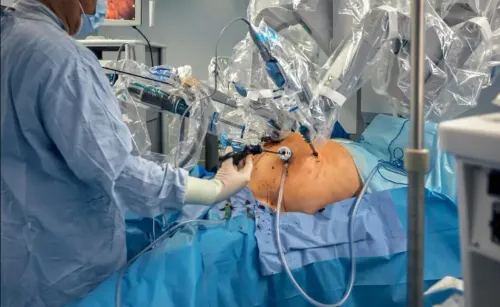
The practical advantage is reduced access trauma, not a smaller operation. Minimally invasive esophagectomy can lower short-term lung complications and shorten hospital stay; in the TIME trial, pulmonary infection occurred in about 12% of minimally invasive cases versus 34% after open surgery. You still face reconstruction, lymph-node removal, feeding support and serious complications.
| Option | Practical advantage | When another choice may be better |
|---|---|---|
| Open esophagectomy | Direct access for difficult anatomy and extensive disease | Large tumours, challenging prior operations or limited minimally invasive expertise |
| Laparoscopic or thoracoscopic surgery | Smaller incisions without robotic equipment | Suitable anatomy when the team has stronger conventional experience |
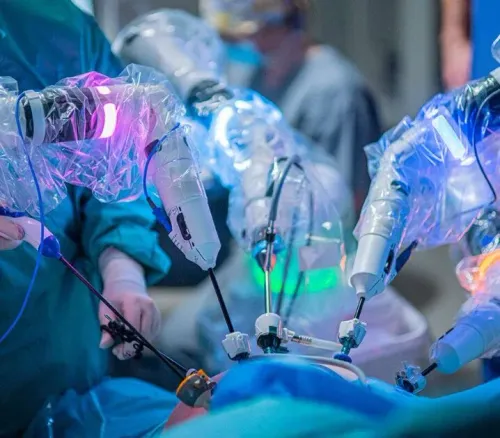
| Robotic surgery | Wristed instruments and magnified views in confined spaces | The surgeon’s learning curve, tumour location or safety concerns outweigh the access benefit |
A GI oncosurgeon assessing robotic esophageal treatment near Yeshwantpur should give personal recent results, not just confirm that a robot is available. Ask for the surgeon’s esophagectomy volume, open-conversion rate, anastomotic-leak rate, pulmonary-complication rate, 30-day or in-hospital mortality, and pathological R0-resection rate.
A high conversion rate is not automatically a failure; converting promptly can prevent a dangerous complication.
Another approach may be better if the tumour requires wider exposure, your anatomy is unusual, or the team performs few robotic cases. The best operation is the one that achieves safe margins and lymph-node clearance with a team experienced in that exact procedure, whether open, laparoscopic, thoracoscopic or robotic.
Value includes recovery, nutrition and the risks you must plan for
An operation is worthwhile when its expected benefit exceeds months of treatment and recovery. For cancer, that benefit may be long-term disease control; for a benign obstruction, it may be reliable swallowing and relief from repeated dilations. Your stage, fitness, nutrition and willingness to complete chemotherapy or chemoradiotherapy all affect the balance.
Recovery does not end at discharge. You may need a feeding tube while swallowing returns, smaller meals to prevent rapid fullness or dumping, and dietary support to halt weight loss. Reflux, altered appetite and fatigue can continue for months, so ask who will monitor your weight, swallowing and nutritional blood tests.
Plan for these burdens and complications:
- Anastomotic leak, which can require drainage, antibiotics, another procedure or prolonged hospitalisation
- Pneumonia and reduced breathing capacity after chest surgery
- Atrial fibrillation, bleeding or blood clots during the early recovery period
- Recurrent-laryngeal-nerve injury causing hoarseness or an unsafe cough
- Readmission, intensive-care treatment or delayed additional cancer therapy
A package price cannot show true value. Request written inclusions for staging, neoadjuvant treatment, theatre costs, intensive care, feeding access, pathology, readmission and complication treatment. A GI oncosurgeon offering robotic esophageal treatment near Yeshwantpur should explain these risks with personal results, not present the robot as a guarantee of easier recovery.
Use a Yeshwantpur consultation to test quality, fit and total value
Ask for measurable results, the complete treatment plan and a written cost estimate before choosing a GI oncosurgeon near Yeshwantpur. A robot alone does not prove experience.
- How many esophagectomies have you personally performed in the past 12 months, and how many were open, laparoscopic, thoracoscopic or robotic?
- What are your personal conversion-to-open, anastomotic-leak, pulmonary-complication and 30-day or in-hospital mortality rates?
- What proportion achieved an R0 resection, meaning no tumour at the pathological margins?
- Who will review my biopsy, contrast scans, PET-CT and endoscopic ultrasound, and do I need chemotherapy or chemoradiotherapy before surgery?
- If this is achalasia, reflux, a stricture or another benign condition, why is esophagectomy preferable to dilation, Heller myotomy, peroral endoscopic myotomy or medical treatment?
- Which hospital team manages intensive care, feeding access, leaks, pneumonia and readmission?
| Compare | What to verify | Why it matters |
|---|---|---|
| Experience | The surgeon’s recent personal numbers, not the hospital’s robot count | Esophagectomy has a substantial learning curve |
| Identity | Full name, recognised qualification, registration, subspecialty training and hospital privileges | “Dr Santosh esophageal surgery” is too vague for safe comparison |
| Price | Pathology, ICU, feeding access, complications, readmission and later therapy included in writing | A package quote can hide major expenses |
| Plan | Cancer stage, tumour location, histology and multidisciplinary recommendations | The operation can change after staging |
Robotic Cancer Surgery can be one clinic to assess, but use the same evidence standard for every gi oncosurgeon esophageal surgery for yeshwantpur option. Choose the team that explains both benefit and failure points clearly.
Related service
ROBOT ASSISTED ESOPHAGEAL SURGERY ROBOT ASSISTED ESOPHAGEAL SURGERY Robot-assisted esophageal surgery provides precision and minimally invasive techniques for treating esophageal conditions such as cancer, achalasia,... View service → |
Frequently asked questions
What should you confirm before considering esophageal surgery?
Confirm whether the condition is benign or cancerous, the biopsy result, the cancer stage and the treatment goal. Metastatic disease may require drug treatment rather than an operation.
What determines the type of esophageal operation?
The disease, tumour location and treatment plan determine the operation. Previous treatment and the extent of disease also affect surgical planning.
Does robotic access make esophageal surgery minor?
No. Robotic access can reduce the strain of surgical access, but esophageal surgery remains major surgery with recovery, nutrition and complication risks.
How should you compare a GI oncosurgeon near Yeshwantpur?
Ask how the surgeon reached the diagnosis and stage, why surgery fits the treatment plan, what recovery involves, how nutrition will be managed and which risks require planning.
Keywords